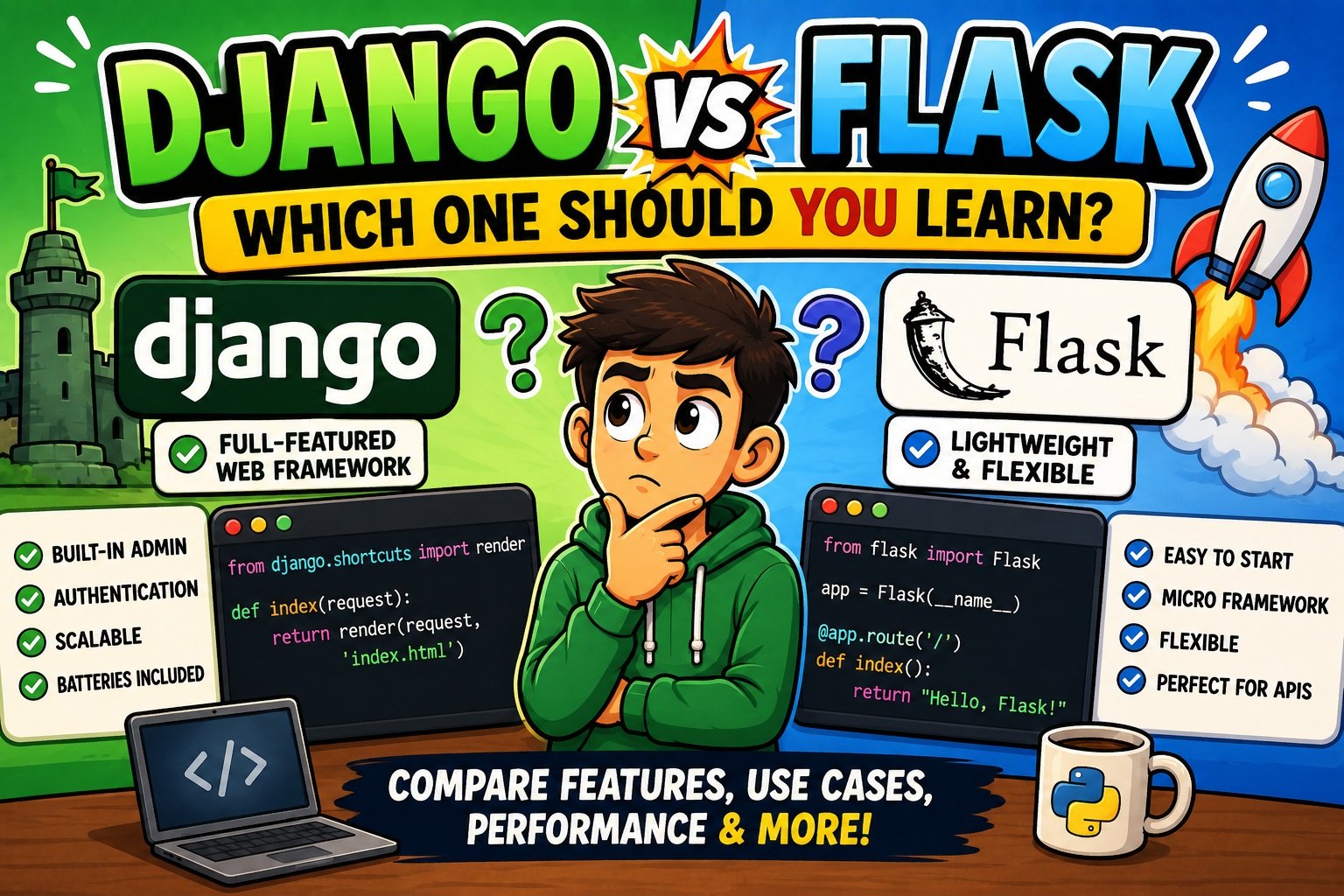
Django vs Flask — Which Python Framework Should You Learn in 2026? (Beginner’s Guide)
If you’ve been learning Python for a while, chances are you’ve heard two names come up again and again when it comes to web development: Django and Flask.
Both are powerful, popular, and built for Python. Both are free and open-source. And yet, they are surprisingly different — almost like choosing between a fully furnished apartment and an empty plot of land.
Picking the wrong one at the wrong time can slow your learning journey, frustrate you with complexity, or leave you feeling like web development is “not for you.” And that would be a shame, because Python web development is one of the most rewarding and in-demand skills you can have in 2026.
This guide is written specifically for beginners and intermediate Python learners who want a clear, honest, no-fluff comparison of Django vs Flask — so you can make the right call and start building with confidence.
Before diving in, make sure your Python fundamentals are solid. If you haven’t already, revisit topics like how to take user input in Python and how to read and write text files in Python — both frameworks build heavily on these core Python concepts.
Let’s get started.
What is Django?
Django is a free, open-source, high-level Python web framework that was first released in 2005 by Adrian Holovaty and Simon Willison. Originally built for newsroom developers who needed to ship web applications fast, Django quickly became one of the most widely used backend frameworks in the world.
Its official slogan says it best:
“The web framework for perfectionists with deadlines.”
Django is what developers call a “batteries-included” framework — meaning it comes with almost everything you need pre-built and ready to use. Think of it like buying a fully equipped kitchen: the oven, fridge, dishwasher, and countertops are all already there. You just need to cook.
What Does Django Include Out of the Box?
- ✅ ORM (Object-Relational Mapper) — interact with databases using Python instead of raw SQL
- ✅ Auto-generated Admin Panel — manage your app’s data through a web UI without writing a single line of admin code
- ✅ User Authentication System — login, logout, password reset, permissions — all built in
- ✅ URL Routing — clean and flexible URL dispatcher
- ✅ Template Engine — render dynamic HTML pages
- ✅ Form Handling & Validation
- ✅ Security Hardening — protection against CSRF, XSS, SQL injection, and clickjacking by default
- ✅ Session and Cookie Management
Django follows the MVT (Model-View-Template) architectural pattern — a variation of the classic MVC pattern — which separates data logic, business logic, and presentation cleanly.
Real-World Companies That Use Django
| Company | How They Use Django |
|---|---|
| Entire backend infrastructure | |
| Core web application | |
| Mozilla | Firefox add-ons website |
| Disqus | Comment platform |
| NASA | Public data portals |
| Spotify | Backend services |
You can learn more from the official Django documentation.
What is Flask?
Flask is a free, open-source, lightweight Python web framework created by Armin Ronacher and released in 2011. It was born from an April Fool’s joke that turned out to be genuinely useful — a proof-of-concept combining two tools: Werkzeug (a WSGI server toolkit) and Jinja2 (a templating library).
Flask’s official slogan is:
“Web development, one drop at a time.”
Flask is called a “microframework” — not because it’s weak or limited, but because its core is deliberately small and non-opinionated. Think of it like an empty plot of land: Flask gives you the land and the zoning permit. You decide what to build, which materials to use, and how the rooms are arranged.
The word “micro” simply means: minimal core, maximum freedom.
What Does Flask Include Out of the Box?
- ✅ Jinja2 Templating Engine
- ✅ Built-in Development Server
- ✅ URL Routing via decorators
- ✅ Request/Response Handling
- ✅ Debug Mode
- ✅ Werkzeug Utilities
- ❌ No built-in ORM (use Flask-SQLAlchemy as an extension)
- ❌ No built-in admin panel (use Flask-Admin)
- ❌ No built-in authentication (use Flask-Login)
Everything Flask doesn’t include out-of-the-box, you can add via extensions — and there are hundreds of them available in the Flask ecosystem.
Real-World Companies That Use Flask
| Company | How They Use Flask |
|---|---|
| Netflix | Internal tooling and data APIs |
| Parts of the web backend | |
| Lyft | Ride-matching APIs |
| Samsung | IoT and device APIs |
| Zillow | Real estate data services |
To see Flask in action right away, check out our full beginner walkthrough: Build a Simple Website Using Flask — The Complete Beginner’s Guide 2026.
You can also explore the official Flask documentation for complete reference material.
Key Differences Between Django and Flask
Here’s a clear, side-by-side comparison to cut through the noise:
| Feature | Django | Flask |
|---|---|---|
| Type | Full-stack framework | Micro-framework |
| First Released | 2005 | 2011 |
| Built-in ORM | ✅ Yes | ❌ No (extension) |
| Admin Panel | ✅ Auto-generated | ❌ Extension needed |
| Authentication | ✅ Built-in | ❌ Extension needed |
| Template Engine | Django Templates | Jinja2 |
| URL Routing | URLconf (urls.py) | Decorators (@app.route) |
| Project Structure | Rigid, predefined | Flexible, custom |
| Learning Curve | Steeper | Gentler |
| Flexibility | Moderate | Very High |
| Performance (small apps) | Heavier | Lighter & faster |
| Scalability (large apps) | Excellent | Good (with effort) |
| Security | Built-in hardening | Extension-dependent |
| Best For | Complex web apps | APIs, microservices, lightweight apps |
| Community Size | Very Large | Large |
| Job Listings (2026) | ~2x more than Flask | Moderate |
The bottom line in 2026: the decision isn’t simply “full-stack vs micro” anymore. It’s about what your project demands and where you are in your learning journey.
Learning Curve Comparison
This is one of the most important factors for beginners, so let’s be completely honest.
Flask — The Gentler Start
Flask is widely considered the easier framework to pick up if you’re new to web development. Why?
Because Flask does less for you automatically, which means there’s less “magic” to understand before your code makes sense. Every line in a Flask project is written by you. You know exactly why it’s there.
Here’s the simplest possible Flask web app:
from flask import Flask

app = Flask(__name__)

@app.route("/")
def home():
    return "Hello, World! Welcome to my Flask app."

if __name__ == "__main__":
    app.run(debug=True)
That’s it. Five lines of real code. A working web server. This is the kind of immediate, satisfying progress that makes learning Flask enjoyable.
Flask’s documentation is also beginner-friendly — it walks you from installation to deployment with clear, jargon-free explanations.
Django — The Structured Learning Curve
Django has a steeper initial learning curve — not because it’s poorly designed, but because there is simply more to understand. When you create a new Django project, several files and folders are generated automatically:
myproject/
├── manage.py
├── myproject/
│   ├── __init__.py
│   ├── settings.py
│   ├── urls.py
│   ├── asgi.py
│   └── wsgi.py
└── myapp/
    ├── migrations/
    ├── admin.py
    ├── apps.py
    ├── models.py
    ├── tests.py
    └── views.py
For beginners, this can feel overwhelming before you’ve even written a single line of your own logic. However, once you understand Django’s structure, building complex features becomes remarkably fast — because the scaffolding is already in place.
Recommended Learning Path
Python Basics → Flask (your first web project) → OOP & Decorators → Django
Speaking of which — understanding Python decorators is genuinely important before working with Flask, because Flask’s routing system is built entirely on them (@app.route). It’s one of those concepts that makes everything click.
Also, before writing your first route in either framework, make sure you’re comfortable debugging Python code step-by-step — catching bugs early is a skill that saves you hours.
Performance and Scalability
Performance: Flask Wins for Small Apps
For lightweight applications, Flask is measurably faster. Because Flask has fewer layers of abstraction and no pre-loaded components, it adds minimal overhead to each request.
A rule of thumb from the developer community: the same feature that takes 24,000 lines in Django might only need 10,000 in Flask — and fewer lines often means faster execution and easier maintenance for simpler apps.
Flask performance snapshot:
Flask (simple API endpoint): ~2,000–5,000 requests/second (Gunicorn, single worker)
Django (same endpoint): ~1,500–3,500 requests/second (similar setup)
Note: Real-world performance depends on your database queries, middleware, caching strategy, and deployment configuration — not just the framework itself.
Scalability: Django Wins for Complex Systems
For large-scale, data-heavy applications, Django’s built-in infrastructure pays off enormously. Instagram, for example, serves billions of users daily — on Django.
Django’s ORM, caching framework, middleware system, and connection pooling support make it far easier to scale vertically without rewriting everything from scratch.
Flask can scale horizontally — and it does so elegantly in microservices architectures and containerized deployments (Docker + Kubernetes). Netflix and Lyft use Flask precisely because of this flexibility.
The 2026 Async Landscape
One important trend shaping the Python web world in 2026: the shift toward ASGI (Asynchronous Server Gateway Interface) to handle concurrent AI workloads, machine learning model serving, and high-throughput API requests.
- Flask supports async natively in newer versions and pairs well with Quart (an async Flask drop-in)
- Django has had ASGI support since version 3.0 and continues to improve it in Django 5.x
Both frameworks are adapting to this shift — but Flask currently has an edge in agile, AI-powered architectures.
Features Comparison: What Each Framework Brings to the Table
Django’s Built-In Feature Stack
Django gives you a production-grade toolkit out of the box:
| Feature | What It Does |
|---|---|
| Django ORM | Maps Python classes to database tables; supports PostgreSQL, MySQL, SQLite, Oracle |
| Admin Panel | Auto-generated UI for managing all your models |
| Auth System | Complete user management: login, logout, registration, password reset, groups, permissions |
| Django REST Framework (DRF) | Industry-standard tool for building REST APIs with Django |
| Template Engine | Django’s own templating language for rendering dynamic HTML |
| Forms | Server-side form rendering and validation |
| Security Middleware | CSRF tokens, XSS filtering, clickjacking protection, SQL injection prevention |
| Caching | Built-in support for Memcached, Redis, file-based caching |
| Internationalization | Multi-language and timezone support out of the box |
Flask’s Extension Ecosystem
Flask achieves the same capabilities through its rich library of extensions:
| Extension | What It Adds |
|---|---|
| Flask-SQLAlchemy | ORM support (SQLite, PostgreSQL, MySQL, etc.) |
| Flask-Login | User session management and authentication |
| Flask-WTF | Form creation and CSRF protection |
| Flask-Migrate | Database migration management |
| Flask-RESTful / Flask-Marshmallow | REST API building blocks |
| Flask-Admin | Admin panel interface |
| Flask-Mail | Email sending support |
| Flask-Caching | Caching layer |
One practical example: if your app needs to send automated emails (like registration confirmations or password resets), Python handles this beautifully with either framework. See our guide on how to send emails automatically using Python to understand the underlying mechanics before wiring it into Flask or Django.
Use Cases for Django
Django shines brightest when your project is complex, data-driven, and needs to scale.
When to Choose Django
1. Large Web Applications Content management systems (CMS), e-commerce platforms, social networks, and SaaS platforms are natural fits for Django. The built-in admin, ORM, and auth system let you ship major features in days instead of weeks.
2. Rapid Enterprise Development If a company needs to build a secure, feature-complete internal tool or customer portal quickly, Django’s scaffolding makes it possible to go from concept to production faster than almost any other option.
3. Government & Institutional Websites Django is trusted by NASA, the UK government, and other public sector organizations because of its built-in security hardening and long-term support culture.
4. News & Publishing Platforms Django was literally built for this. The Guardian, Disqus, and several major newspapers run Django at their core.
5. API Backends with Django REST Framework DRF turns Django into a powerful REST API engine — with serializers, viewsets, authentication, pagination, and filtering all baked in.
Real Django Code Example — A Simple View
# views.py
from django.http import HttpResponse

def home(request):
    return HttpResponse("Hello from Django!")
# urls.py
from django.urls import path
from . import views

urlpatterns = [
    path("", views.home, name="home"),
]
Use Cases for Flask
Flask is the go-to choice when you need speed of development, maximum control, or a lightweight footprint.
When to Choose Flask
1. REST APIs and Microservices Flask’s minimal core makes it ideal for building focused, fast API endpoints. Netflix uses Flask for specific internal services precisely because it doesn’t carry unnecessary overhead.
2. Machine Learning Model Deployment This is Flask’s biggest growth area in 2026. Data scientists deploying ML models — whether from scikit-learn, TensorFlow, or PyTorch — reach for Flask because it lets them wrap a model in an API endpoint in minutes.
from flask import Flask, request, jsonify
import pickle

app = Flask(__name__)
model = pickle.load(open("model.pkl", "rb"))

@app.route("/predict", methods=["POST"])
def predict():
    data = request.json["features"]
    prediction = model.predict([data])
    return jsonify({"prediction": prediction[0]})

if __name__ == "__main__":
    app.run(debug=True)
3. Data-Driven Dashboards Flask pairs naturally with data tools. If you’re working with datasets, our Pandas Tutorial for Beginners 2026 is a perfect companion — Flask + Pandas is a common stack for building lightweight analytics dashboards.
4. Prototyping and MVPs When you need to validate an idea quickly, Flask lets you go from zero to a working prototype in an afternoon.
5. Learning Web Development Fundamentals Because Flask doesn’t hide anything from you, it’s an excellent teacher. You learn how routing works, how requests are handled, and how templates are rendered — all by writing it yourself.
Django vs Flask for Beginners
This is the question most beginners actually want answered, so let’s be direct.
Flask is the Better Starting Point for Most Beginners
If you’re new to web development — or even if Python is still relatively new to you — start with Flask. Here’s why:
- The codebase is smaller and easier to read
- You build from scratch, so you understand every line
- The learning curve is gentler — you see results immediately
- Flask’s documentation is welcoming and clear
- You won’t be confused by auto-generated files you didn’t write
Django is Better if You Already Know Python Well
If you’ve been writing Python for 3–6+ months, understand functions, classes, and modules, and want to build something production-ready quickly — Django will reward you faster than you’d expect.
Django’s rigid structure is actually a feature, not a bug, for experienced developers. It enforces best practices and keeps large codebases consistent.
The Honest Recommendation
New to Python?          → Learn Python basics first.
Know Python basics?     → Start with Flask.
Comfortable with OOP?   → Transition to Django.
Want a job quickly?     → Learn Django (more job listings in 2026).
Building an AI/ML API?  → Flask is your best friend.
Before diving into either framework, strengthen your Python foundations. Practicing with 50 Python coding questions is a great way to make sure you’re truly ready. Understanding Object-Oriented Programming in Python is especially important before tackling Django’s class-based views.
Job Opportunities and Career Scope in 2026
The Python web development job market in 2026 is healthy and growing — but Django and Flask lead to somewhat different career paths.
Django Job Market
- Django developers have nearly twice as many job listings as Flask developers on platforms like Indeed, LinkedIn, and Glassdoor
- Roles: Backend Python Developer, Full Stack Developer, Django Developer, CMS Developer
- Django is the dominant choice for companies building feature-complete web platforms
- Average salary range (global, 2026): $80,000–$130,000 USD/year depending on experience and location
Flask Job Market
- Flask is more often listed as a skill within a broader role (e.g., “Python Backend Developer with Flask experience”) rather than a standalone job title
- Roles: API Developer, ML Engineer (Backend), Microservices Developer, Data API Developer
- High demand in AI/ML teams deploying models as APIs
- Average salary range: $75,000–$120,000 USD/year
The FastAPI Wildcard
It’s worth acknowledging: FastAPI has become a serious third contender in 2026, especially for high-performance async APIs and ML model serving. If you’re planning to work heavily in AI, FastAPI is worth learning after Flask — its syntax will feel familiar.
However, for traditional web application development, the choice still comes down to Flask vs Django.
Top 3 Frameworks by Python Developer Usage (2026)
1. Django      — Enterprise, full-stack, job-market leader
2. Flask       — APIs, microservices, AI/ML
3. FastAPI     — High-performance async APIs
If you’re preparing for Python developer interviews, our list of Top 20 Python Interview Questions for Beginners 2026 covers the framework questions you’re most likely to face.
Pros and Cons of Django
✅ Pros of Django
1. Batteries Included Everything you need for a production-grade web app is already built in — ORM, auth, admin, security, forms. You spend less time wiring things together and more time building your actual product.
2. Excellent Built-In Security Django protects you from CSRF, XSS, SQL injection, and clickjacking by default. Security best practices are baked into the framework’s DNA — which is why it’s trusted by government organizations and large enterprises.
3. Auto-Generated Admin Panel With literally a few lines of code, Django creates a fully functional admin dashboard for your models. This is a massive productivity boost for data management.
4. Massive Community and Ecosystem Django has one of the largest Python communities. Getting help, finding tutorials, and hiring developers is straightforward.
5. Django REST Framework (DRF) DRF is the industry-standard way to build REST APIs with Python. It’s mature, well-documented, and powerful.
6. Long-Term Support (LTS) Releases Django releases LTS versions with multi-year security support — important for enterprise projects that can’t constantly update their stack.
❌ Cons of Django
1. Steep Initial Learning Curve The sheer number of concepts — models, views, templates, URLconf, settings, migrations — can overwhelm beginners.
2. Too Heavy for Simple Projects Django’s overhead is unnecessary for a simple REST API or a lightweight tool. You’re loading a sports car to carry a grocery bag.
3. Less Flexibility Django is opinionated. It has “the Django way” of doing things — and while this is great for consistency, it can feel restrictive if you want to make unconventional architectural choices.
4. Slower for Minimalist Use Cases For a simple API that returns JSON, Django’s full request/response cycle has more moving parts than Flask, adding unnecessary latency.
Pros and Cons of Flask
✅ Pros of Flask
1. Simple and Beginner-Friendly Flask’s minimal core means you’re not overwhelmed on day one. Your first working app can be five lines of code.
2. Maximum Flexibility You choose your database, ORM, authentication library, and project structure. Flask trusts you to make good decisions — or learn from bad ones.
3. Lightweight and Fast for Small Apps Less overhead means faster response times for simple applications and APIs.
4. Perfect for AI/ML Deployment Deploying a machine learning model as a web API? Flask is the first tool most data scientists reach for — and for good reason.
5. Great for Learning Web Concepts Because Flask doesn’t abstract away the details, it teaches you how web applications actually work. That foundational knowledge makes learning Django later much easier.
6. Thrives in Microservices Architecture Flask’s lightweight nature makes it a natural fit for containerized, independently deployable services.
❌ Cons of Flask
1. No Enforced Structure Because Flask gives you total freedom, two Flask projects can look completely different. This inconsistency can be a maintenance nightmare for teams.
2. More Setup for Complex Features Every feature beyond basic routing — database access, authentication, email, admin panel — requires finding, installing, and configuring the right extension. This adds time and decision fatigue.
3. Security is Extension-Dependent Unlike Django, Flask doesn’t come with hardened security defaults. If you don’t configure Flask-WTF for CSRF protection or set up HTTPS correctly, your app is vulnerable.
4. Less Structure = More Decisions Freedom is great — until you have to make twenty architectural decisions before you’ve written a single business logic line.
Which One Should You Learn First?
After all that comparison, here’s the honest, experience-based answer:
👶 If You’re a Beginner — Start with Flask
Flask will teach you how the web works without drowning you in framework conventions. You’ll understand routing, request handling, templating, and database connections at a fundamental level. That knowledge is invaluable when you later move to Django.
💼 If You Want a Job Quickly — Learn Django
The job market data is clear: Django has nearly twice as many job listings as Flask. If your goal is employment as a Python web developer within the next 6–12 months, prioritize Django.
🤖 If You’re Interested in AI/ML — Flask First, FastAPI Next
Flask is the dominant tool for ML model deployment in 2026. After Flask, add FastAPI to your toolkit for async-first API development.
🏗️ If You’re Building a Large Application — Django
For anything with user authentication, a database, an admin panel, and multiple features — Django will save you enormous time and reduce security risks.
The Universal Learning Path
Step 1: Python Basics (variables, functions, loops, files)
Step 2: Object-Oriented Programming
Step 3: Build a small Flask project (website or API)
Step 4: Learn SQL & database basics
Step 5: Transition to Django
Step 6: Build a full-stack Django project
Step 7: Add Django REST Framework
Step 8 (Optional): Explore FastAPI for async APIs
Both frameworks are future-ready. Flask is leading the charge in agile, AI-powered solutions. Django continues to dominate enterprise and full-stack web development. You don’t have to choose one forever — many professional Python developers know and use both.
If you’re looking for structured practice before you commit to a framework, try building a Guess the Number Game in Python first. It’s a satisfying beginner project that sharpens your Python logic — and logic is the foundation of everything in web development.
And if you’re not sure what to build next, the PyCodeRoom AI Task Generator can generate personalized Python practice ideas based on your current skill level.
FAQs
1. Is Django better than Flask for beginners?
Not necessarily. Flask has a gentler learning curve and is better for absolute beginners. Django is better once you have a solid Python foundation and want to build complex, feature-rich applications.
2. Which is faster — Django or Flask?
Flask is generally faster for lightweight applications and simple APIs because it carries less overhead. Django performs better in complex, data-heavy applications where its built-in caching and ORM optimization shine.
3. Can I learn Flask before Django?
Absolutely — and it’s actually recommended. Flask teaches you web fundamentals clearly. Once you understand routing, requests, and templates in Flask, Django’s concepts become much easier to grasp.
4. Is Flask good for large projects?
Yes, with proper architecture. Flask scales well in microservices and containerized environments. However, Django is generally easier to maintain for large monolithic applications because of its enforced structure.
5. Does Django require knowledge of Flask?
No. Django and Flask are independent frameworks. However, understanding Flask first makes Django easier to learn.
6. Which Python framework pays more — Django or Flask?
Salaries are comparable, but Django developers often have slightly higher earning potential due to higher job market demand and the complexity of projects they typically handle.
7. Is Flask still worth learning in 2026?
Absolutely. Flask is thriving in the AI/ML deployment space, microservices architecture, and prototyping. Its simplicity and flexibility make it more relevant than ever.
8. What companies use Django?
Instagram, Pinterest, Mozilla, Disqus, NASA, and Spotify are among the most notable Django users.
9. What companies use Flask?
Netflix, Reddit, Lyft, Samsung, and Zillow use Flask for specific services and APIs.
10. Can I use Django and Flask together in the same project?
Yes. Some organizations use Django for their main web application and Flask (or FastAPI) for specific microservices or ML APIs. They can communicate via REST APIs.
Conclusion
The Django vs Flask debate doesn’t have a single right answer — it has the right answer for you, right now, based on your goals.
Start with Flask if you’re new to web development, want to understand how the web works under the hood, or need to build an API or ML-powered service quickly.
Move to Django when your Python is strong, you want a job-ready skill, or you’re building something complex with authentication, a database, and multiple features.
Both frameworks are battle-tested, actively maintained, and backed by strong communities as of 2026. Learning either one puts you on a clear path toward a career in Python web development.